The stained-glass windows
The stained-glass windows by Arcabas
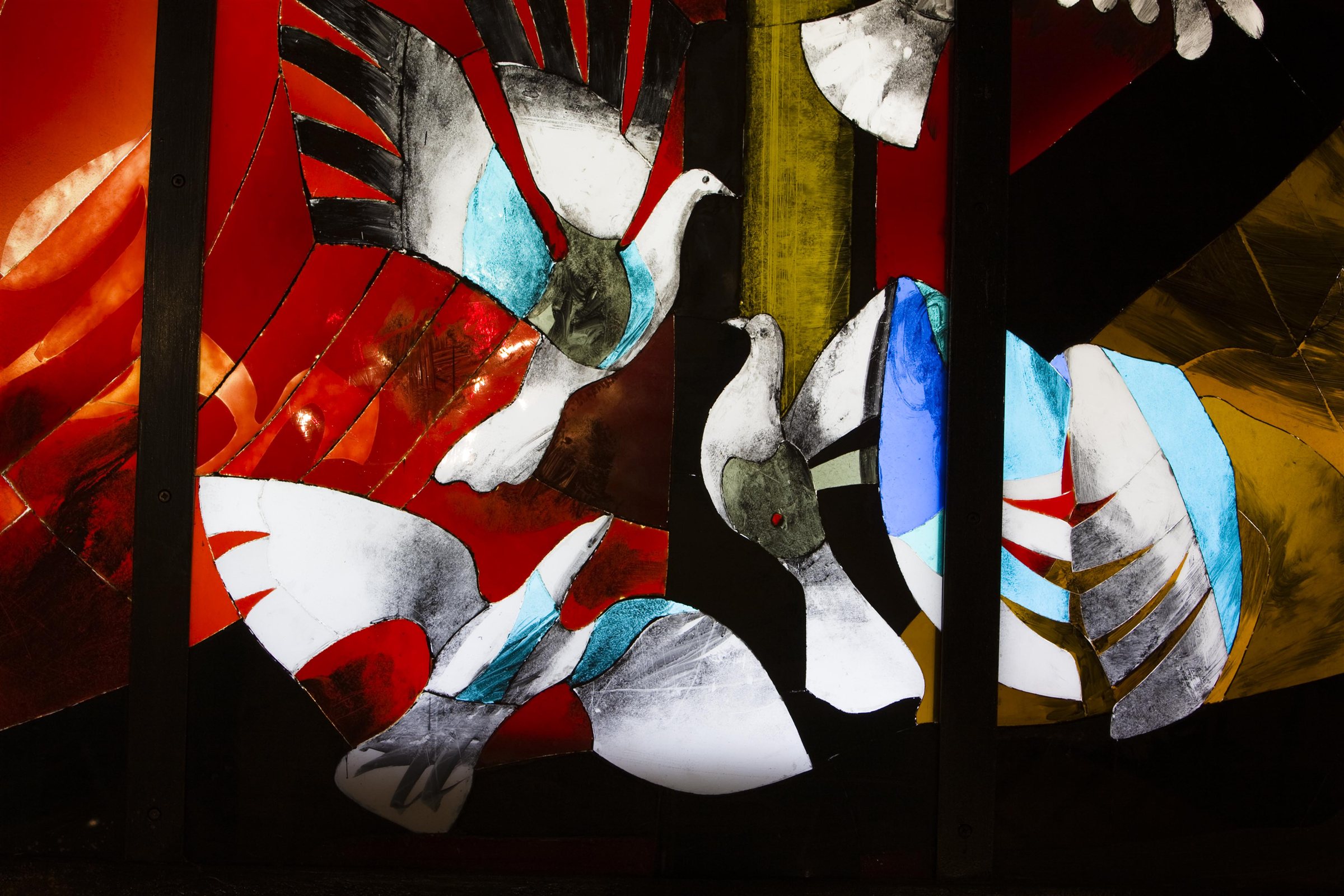
Thirteen stained-glass windows, a painting in light of Mark’s Gospel.
In pictures
The windows in detail
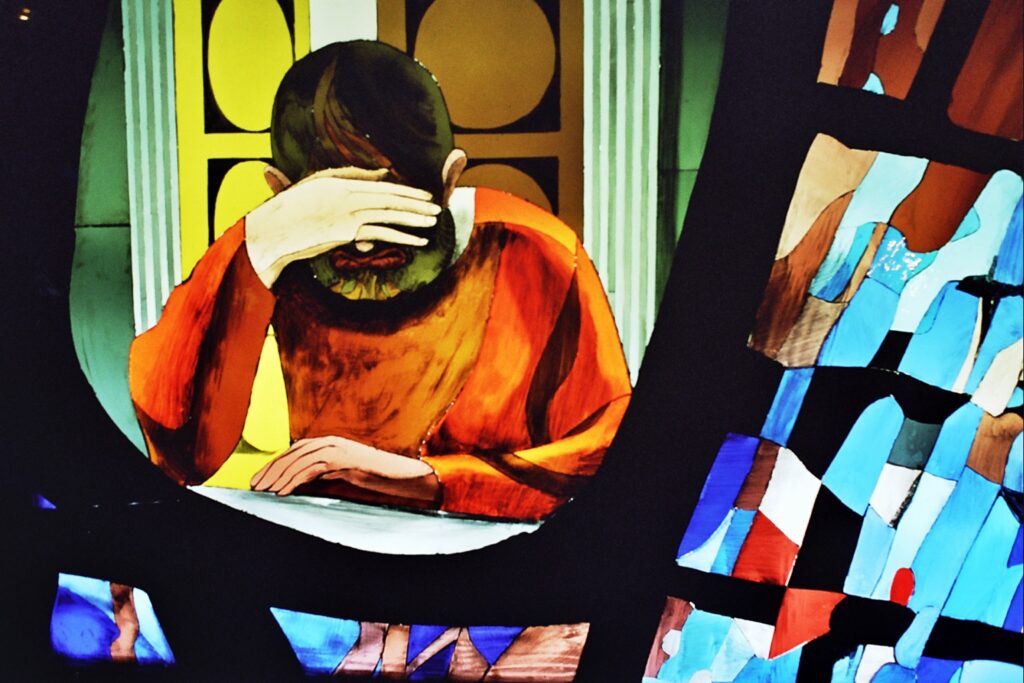
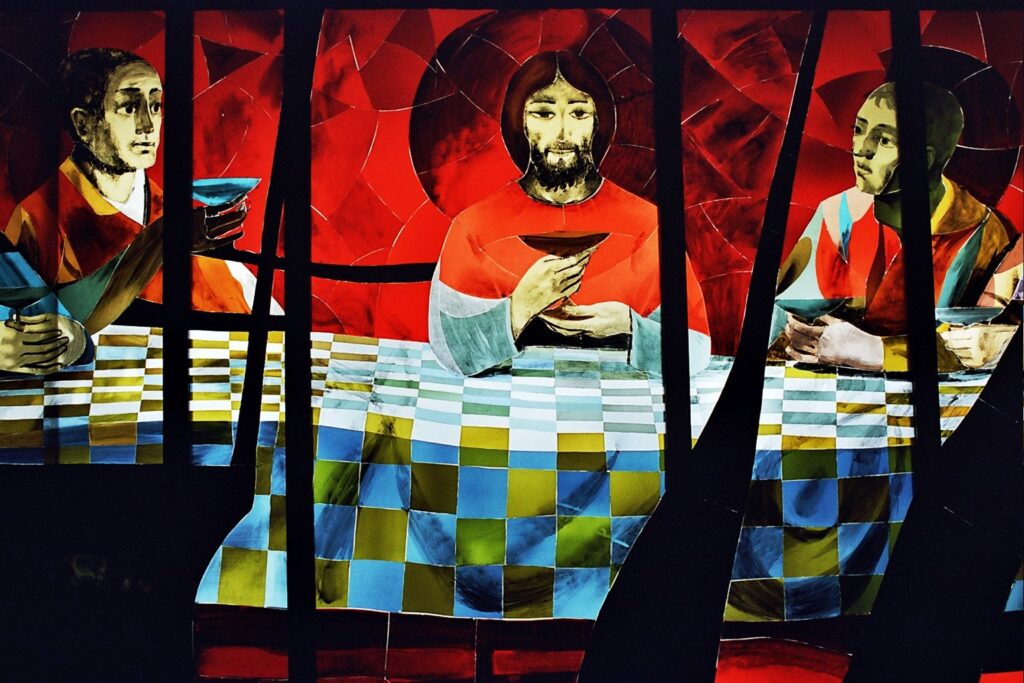
The work
The Gospel according to Mark, a painting in light
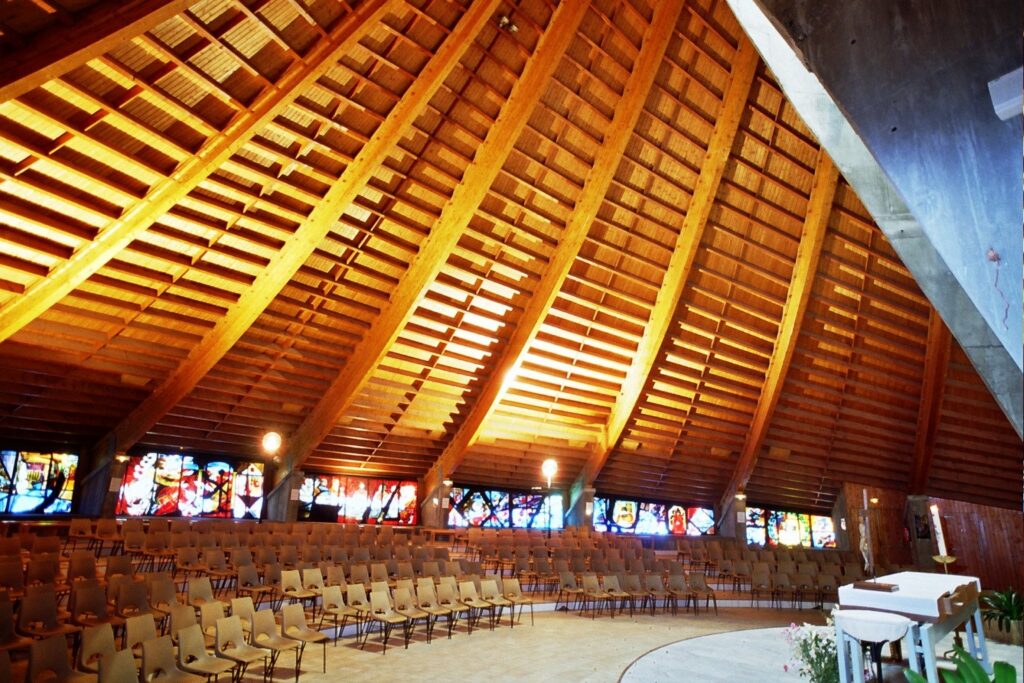
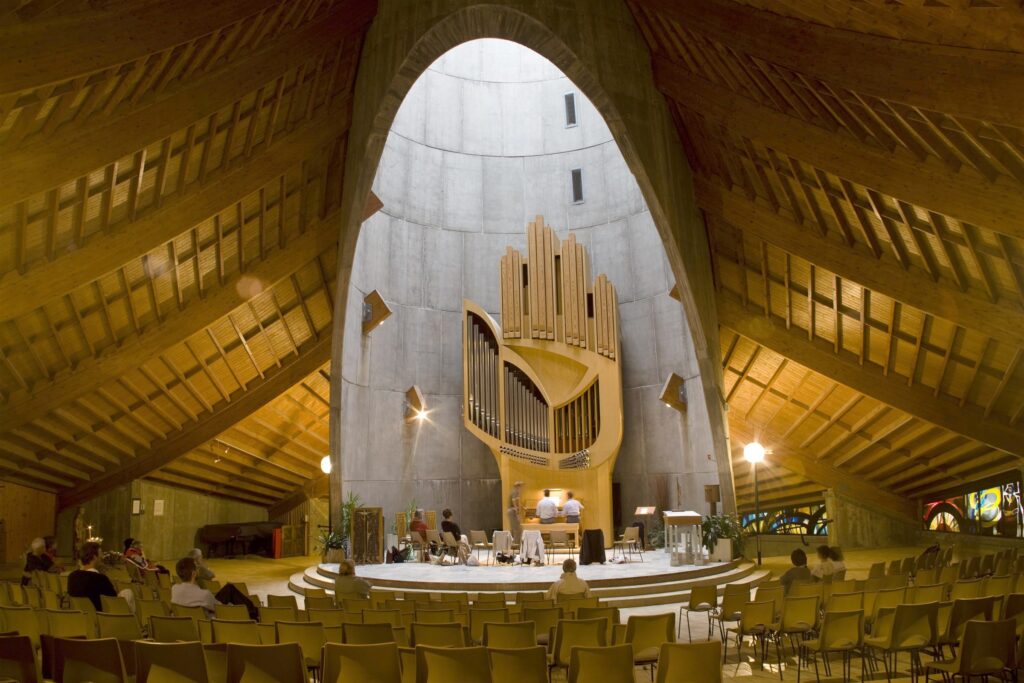
Thirteen stained-glass windows, set between the abutments of the wooden arches that outline the tent, transform the light, as the sun’s rays once filtered through primeval forests.
Created by the artist Jean-Marie Pirot, known as Arcabas (1926-2018), they illustrate scenes from the Gospel according to Saint Mark in brilliant colours. Made between 1990 and 2002, these windows were produced by the master glaziers Françoise Montfollet and then Christophe Berthier, and installed by the master craftsman Léon Sert.
These scenes trace a path of faith: alive to the scandal of suffering and death, they seek to lead the viewer to give them meaning by following Christ. With great dramatic power, they offer a moving approach to the mystery of his incarnation and resurrection.
13
Windows
1990 – 2002
Created
60 m
Total length
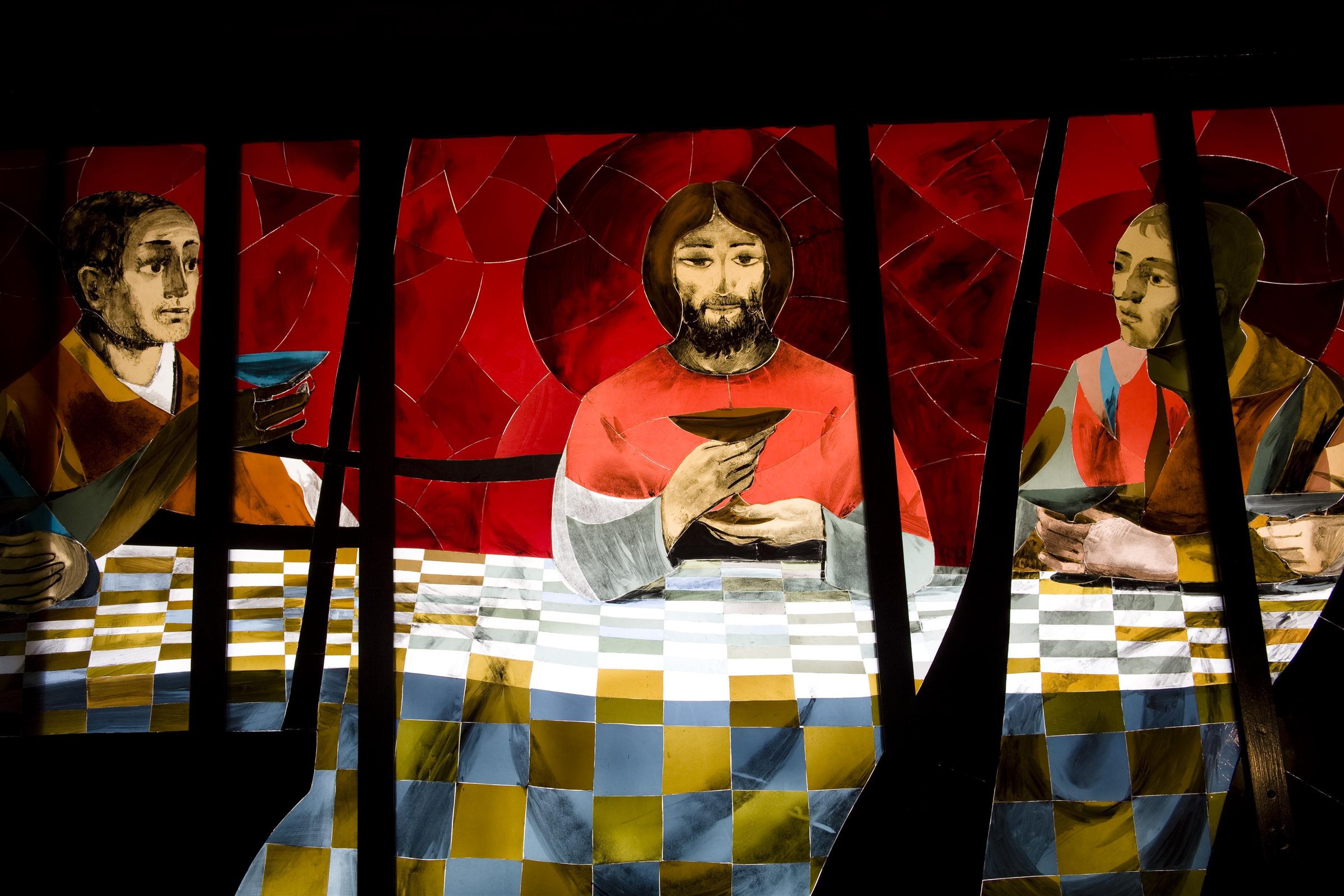
Centrepiece
The Last Supper
Inaugurated on 6 March 1994 under the honorary patronage of Jacques Toubon, Minister of Culture, this window is dedicated to Father Jaap Reuten.
It shows Jesus’ last meal with his disciples (Mark 14:22-25).
From left to right
The thirteen windows
The church’s architecture, with a total length of 60 linear metres, lends itself perfectly to illustrating a few chapters of the Gospel according to Saint Mark.
01
“The dance of Salome and…”
Mark 6:17-29
Inaugurated together with the next one on 15 August 1998 by Father Joost De Waele, in the presence of Arcabas, thanks to the generosity of members and friends of the association.
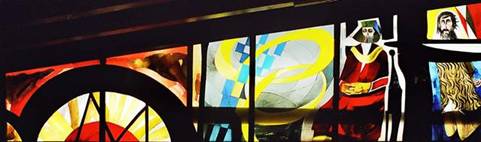
02
“… the death of John the Baptist”
Mark 6:17-29
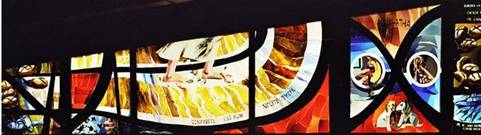
03
“Jesus walks on the water”
Mark 6:45-52
And Jesus feeds 5,000 men, What makes a person unclean, Ephphatha, Jesus feeds 4,000 men. The first window installed, inaugurated on 25 December 1990, given for Father Jaap Reuten’s 25 years of ministry in L’Alpe d’Huez.
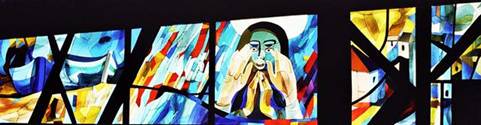
04
“The healing of the blind man of Bethsaida”
Mark 8:22-26
Inaugurated together with the next one on 15 August 1997 by Father Joost De Waele, in the presence of Arcabas.
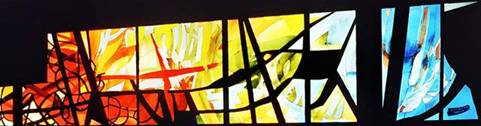
05
“Jesus foretells his death and resurrection”
Mark 8:31-33; 9:30-32; 10:32-34
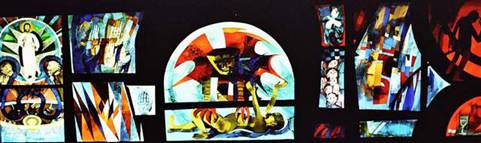
06
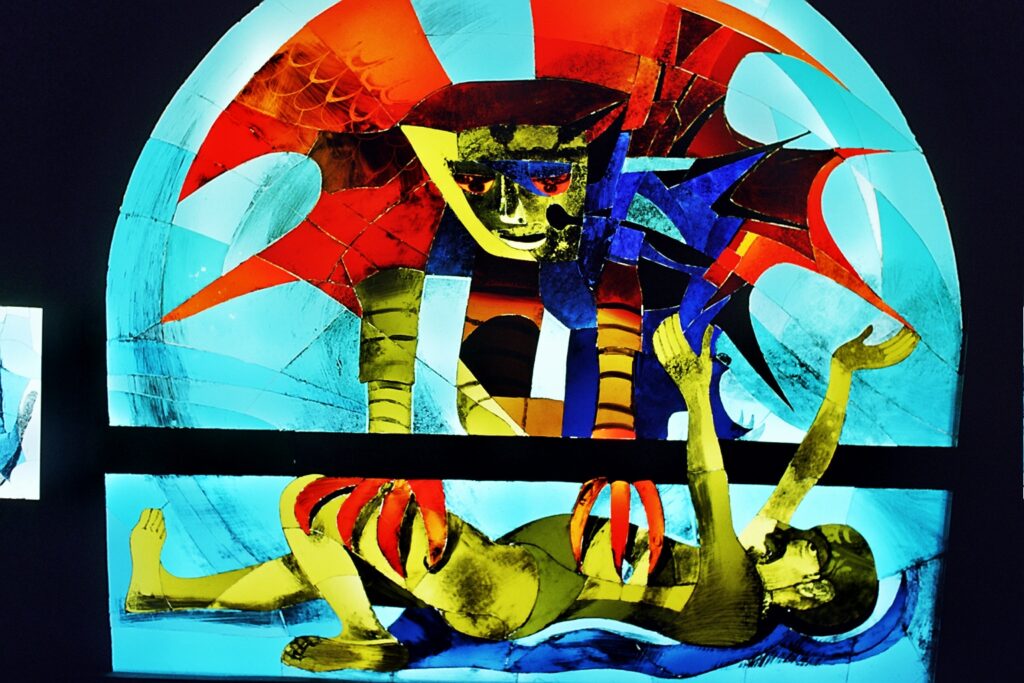
“The healing of a possessed child”
Mark 9:17-29
And the Transfiguration, Jesus blesses the little children, The rich man. Inaugurated at the feast of Notre-Dame des Neiges, on 9 August 1992.
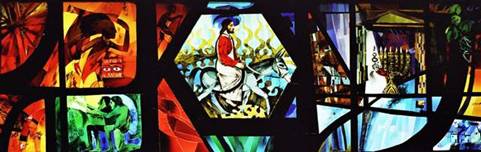
07
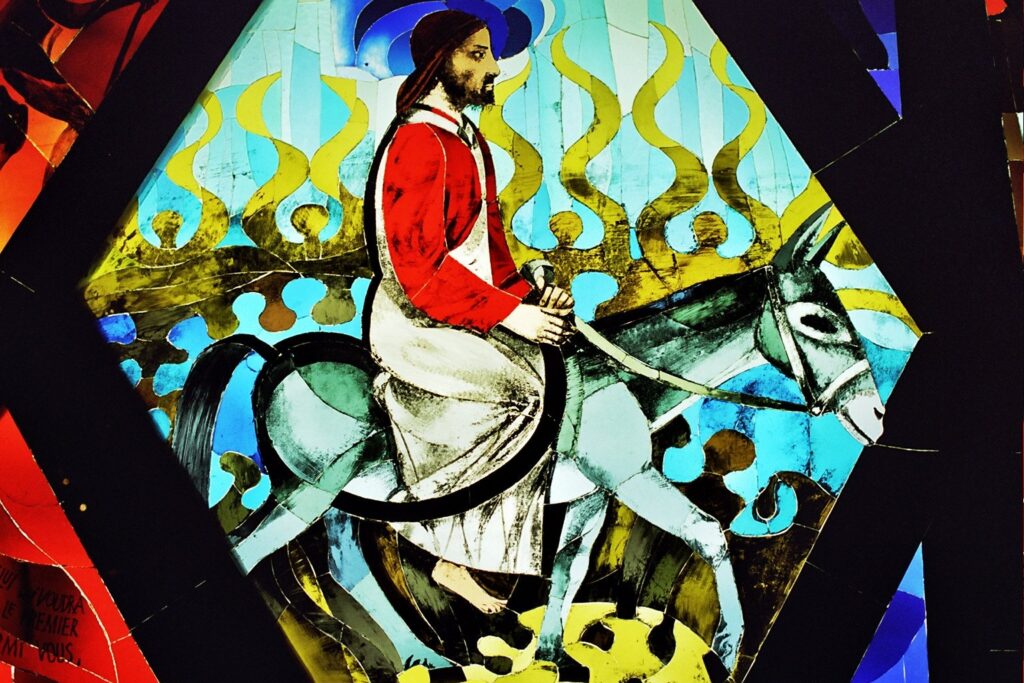
“Jesus enters Jerusalem”
Mark 11:1-11
And blind Bartimaeus, the barren fig tree. Given by an anonymous patron, inaugurated on 2 April 1991 by Father Jaap Reuten.
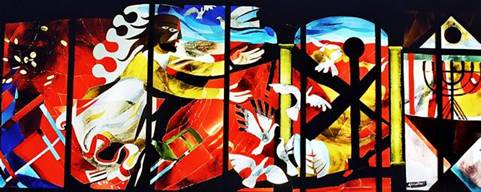
08
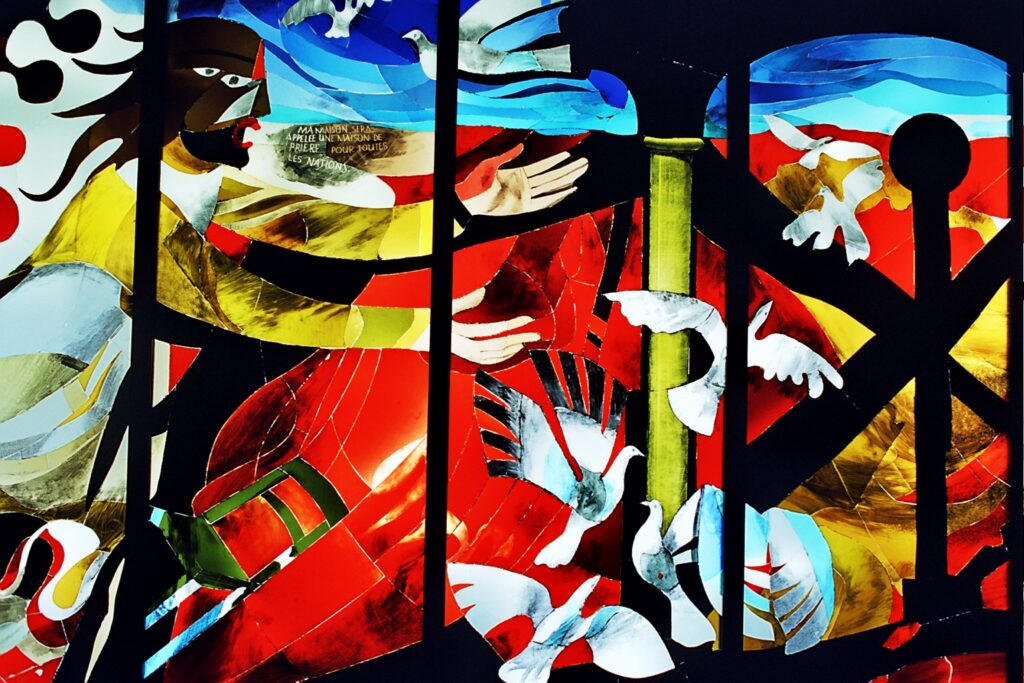
“Jesus drives the merchants from the Temple”
Mark 11:15-19
The largest window (10.7 m²), inaugurated on 15 August 1994 after the Mass of the Assumption.
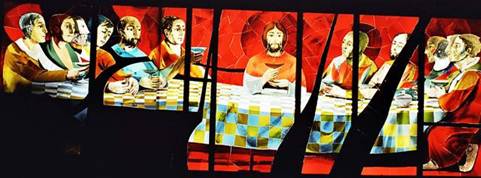
09
“The Last Supper”
Mark 14:22-25
Inaugurated on 6 March 1994 under the honorary patronage of Jacques Toubon, Minister of Culture. Dedicated to Father Jaap Reuten.
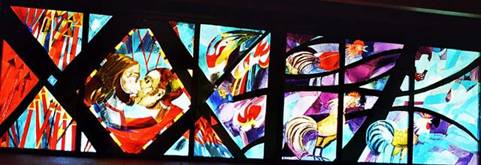
10
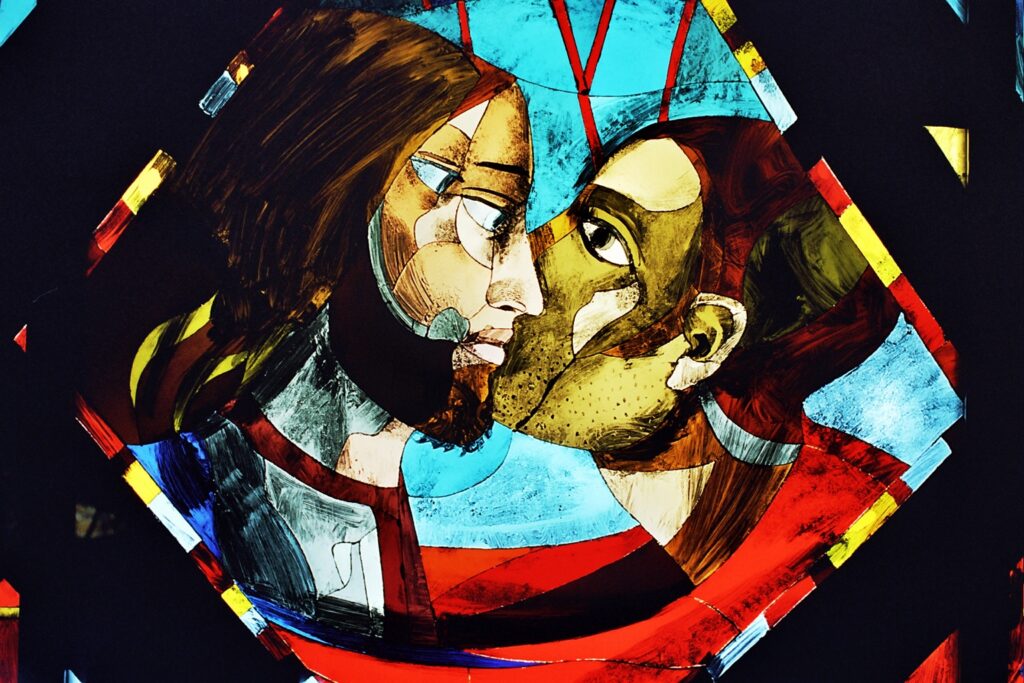
“The kiss of Judas and Peter’s denial”
Mark 14:43-46, 66-72
Inaugurated on 13 August 1995, in the presence of Arcabas, for the 25th anniversary of the Notre-Dame des Neiges Centre.
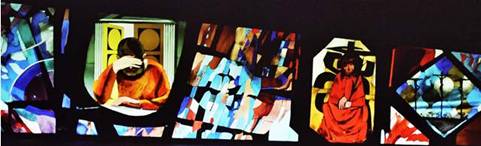
11
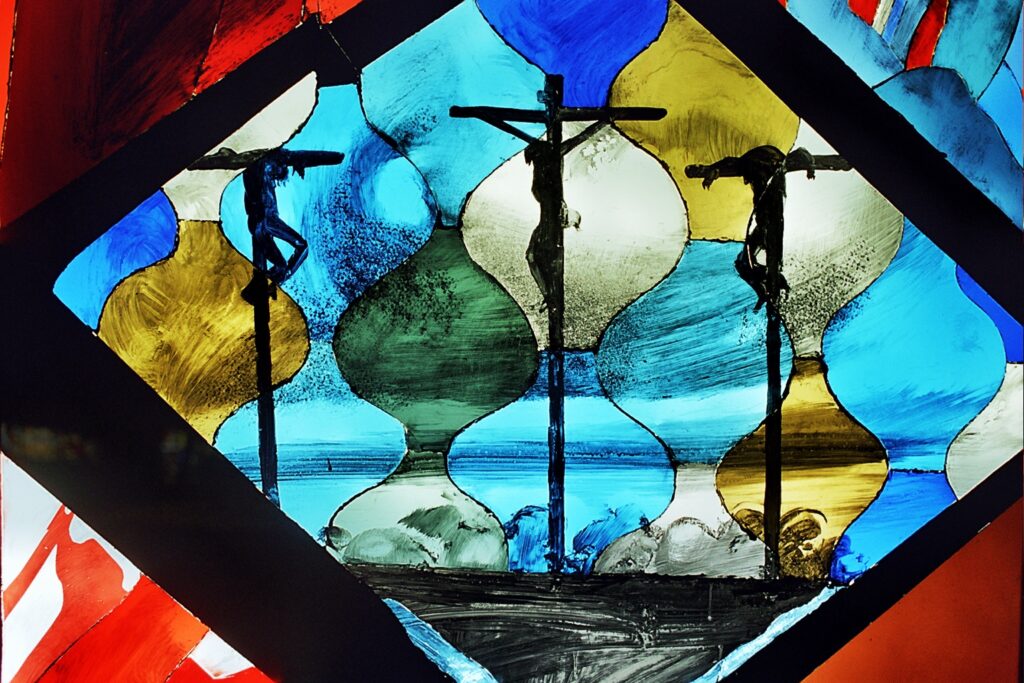
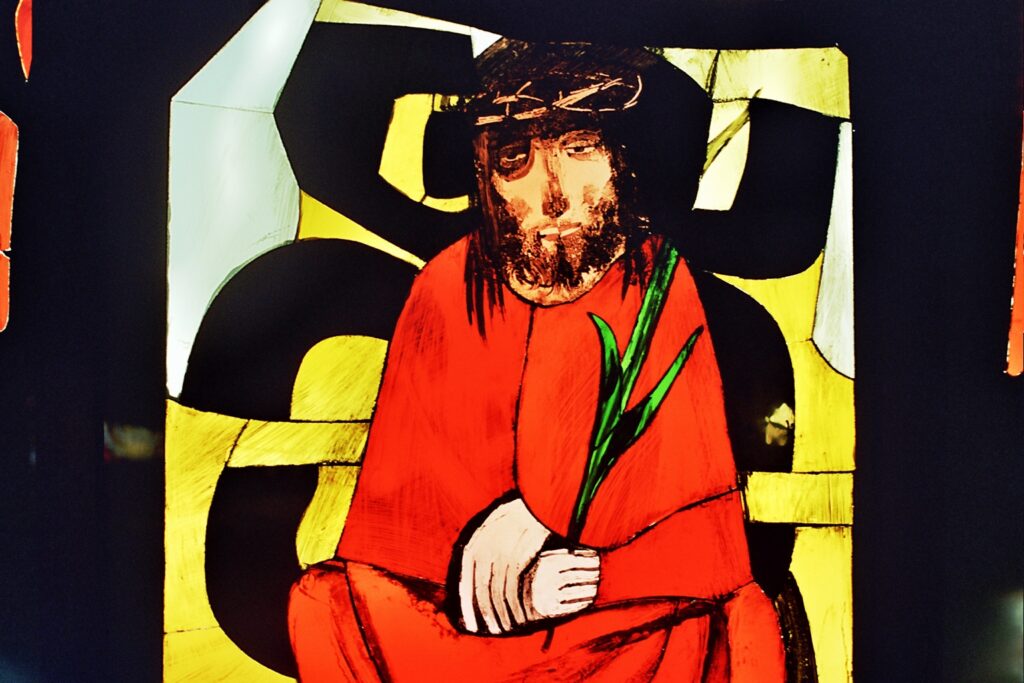
“The mocking and passion of Jesus”
Mark 15:16-37
Inaugurated on 11 August 1996 by Father Joost De Waele.
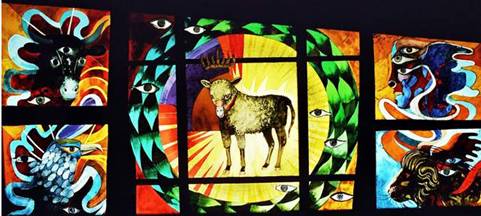
12
“The Lamb of God”
Revelation 4:6-8 and 5-6
Framed by the symbolic representations of the four Evangelists. Inaugurated on 17 April 1995 by Father Louis Tronchon.
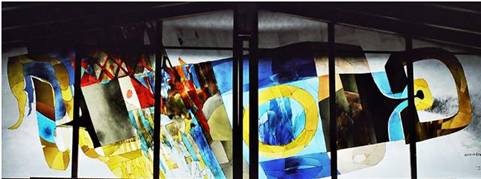
13
“The Alpha and the Omega”
Above the entrance door
The last window (9.36 m²), inaugurated on 22 December 2002 in the presence of Arcabas.
Photos of the windows: Jean-François Capelle.
The artist
Arcabas (1926-2018)
Born in 1926 and a graduate of the École nationale supérieure des Beaux-Arts in Paris, Arcabas held many exhibitions, both in France (Paris, Lyon, Grenoble, Marseille, Strasbourg…) and abroad (Berlin, Ottawa, Frankfurt, Ostend, Panama, Luxembourg). His works are found in Europe as well as in Canada, Japan, the USA, Mexico… in various public collections (Grenoble Museum, Bibliothèque nationale in Paris, the International Pinacotheca of Waterloo and the University of Ottawa Museum in Canada, Cuernavaca in Mexico) and private collections. He also carried out various works for the French government and local authorities (mosaics, frescoes, stained glass), as well as for the Grenoble prefecture, the Grenoble Institute of Political Studies, the Promotion sociale in Chambéry, the lycée in Metz, the ecumenical church in Chamrousse and the church of Saint-Augustin in Grenoble.
The ensemble of sacred art in the church of Saint-Hugues-de-Chartreuse, begun in 1953 and completed in 1986, is his principal monumental work. It was donated to the Isère department as part of its heritage. The work has an international reputation, and the church receives an estimated 100,000 visitors a year.
In the theatre, from 1961 to 1972, he designed the sets and costumes for The Dance of Death by Strindberg, The Diary of a Country Priest by Bernanos and The Just by Camus with the Comédie des Alpes, and The Soldier’s Tale by Ramuz and Stravinsky at the Opera of Canada’s National Arts Centre.
Full professor and head of the painting studio at the École des arts décoratifs in Grenoble from 1950 to 1969, then “guest artist” of the Canada Council for the Arts and full professor at the University of Ottawa from 1969 to 1972, he founded and directed the “Collective Experimental Workshop”. Back in France, he founded and directed the “Éloge de la main” visual arts studio at the University of Social Sciences in Grenoble.
From 1986, he lived and worked in Saint-Pierre-de-Chartreuse, in the Isère. While completing his painted work, shown in an exhibition of 95 canvases at Grenoble town hall (June-September 1993), he carried out several monumental works, such as the lycée du Grésivaudan in Meylan, Isère (painting), the water treatment plant of the Grésivaudan valley in Fontanil-Cornillon, Isère (painting and sculpture), the basilica of La Salette, Isère (painting), the church of Saint-Ismier, Isère (stained glass), Saint-Malo Cathedral in Ille-et-Vilaine (altar, baptistery, liturgical furniture), the church of Saint-Vincent de Paul in Grenoble (painting), Rennes Cathedral (liturgical furniture, sculpture), the Torre de Roveri chapel in Bergamo, Italy (stained glass, paintings, ceramics, sculptures, liturgical furniture), the church of Corbel, Isère (stained glass), the church of Saint-Paul in Meythet, Annecy (a 72 m² fresco), the church of Saint-Pierre in Cognin, Chambéry (a three-panel altarpiece), the liturgical furniture of Robert Schuman’s chapel in Scy-Chazelles, Moselle, the recently completed basilica in Grenoble, and the thirteen stained-glass windows of Notre-Dame des Neiges in L’Alpe d’Huez, completed in 2002. He died in 2018.
A booklet written by Father Joost De Waele, who succeeded Father Jaap Reuten in 1992, presents these windows and places each scene in its Gospel context. It is also available in English, Dutch, German and Spanish, and is on sale in the church (€4).
Bibliography
Arcabas, Saint-Hugues de Chartreuse, text by François BŒSPFLUG, photographs by Helmuth Nils LOOSE, Éditions du Cerf – Éditions du Tricorne, 1994, 182 pages.
Le polyptyque de l’enfance du Christ et autres œuvres : Arcabas, text by François BŒSPFLUG, photographs by Joris LUYTEN and ALLEGRET, preface by H. E. Cardinal Godfried Danneels, Éditions Halewijn, Antwerp 2002, 110 pages.
Craftsmanship
The art of stained glass
The art of stained glass uses age-old techniques. First, a very precise 1:10 scale model is made, showing the subjects, the decoration, the arrangement of the areas of colour and the line of the joints. Enlarged to full size, it allows the exact position of each element to be refined. The master glazier then chooses the colours proposed by the artist; the sheets of glass are cut with a diamond, some pieces are painted directly by the artist, then fired at 650 °C.
At Notre-Dame des Neiges, a new assembly technique was used, layering antique glass onto laminated glass with a highly suitable Saint-Gobain adhesive, thus doing away with the lead of traditional setting.
The church