

History
The history of Notre-Dame des Neiges
From the small wooden chapel to Jean Marol’s church, inaugurated on 6 December 1969 and completed in 2002 with the installation of the thirteenth stained-glass window.
30 Dec. 1968
Crypt consecrated
6 Dec. 1969
Inauguration
1978
Organ inaugurated
2002
Thirteenth window
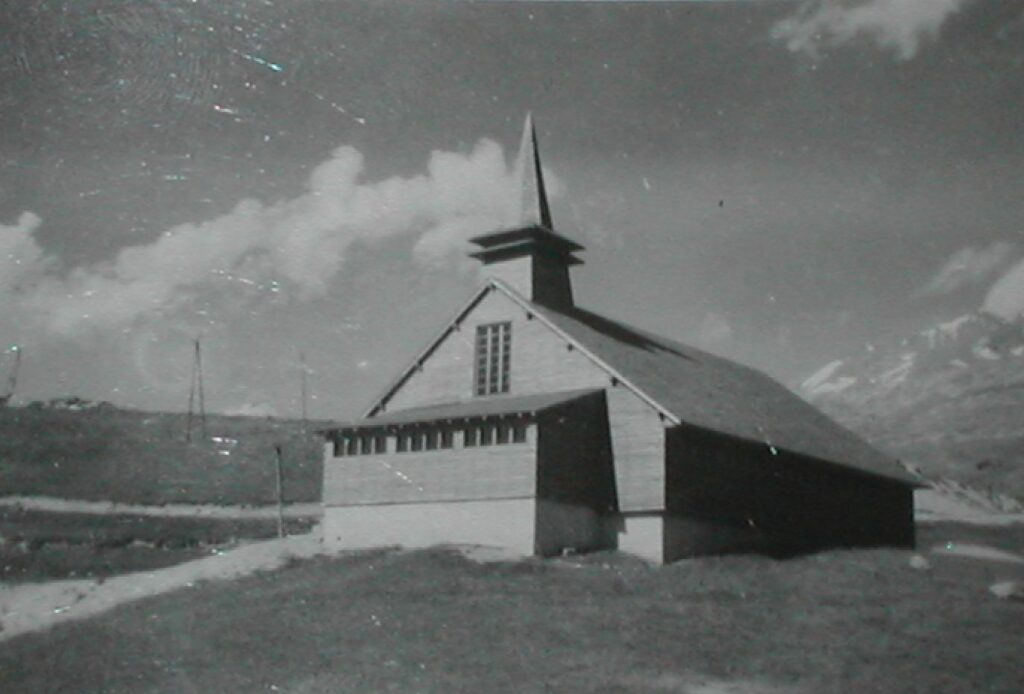
The wooden chapel, before the church was built.
A church for the 1968 Games
While preparing for the 1968 Olympic Games, the idea arose of replacing the small wooden chapel of L’Alpe d’Huez with a larger church, from which the Meije can be seen.
Under the impetus of the Dutch priest Father Jaap Reuten, priest there from 1964 to 1992, the Notre-Dame des Neiges church was completed in 1970, funded by donations from many benefactors, thanks to three associations he founded: one to build the building and the stained-glass windows (the Notre-Dame des Neiges association, registered with the prefecture on 17 January 1967), another to install an organ (the Orgues et Montagnes association, now merged with Notre-Dame des Neiges), and a third dissolved in the early years.
God pitched his tent in L’Alpe d’Huez
With the help of Jean Le Boucher, who had vowed during the war, at the battle of the Alpette on 14 August 1944, to build a church in honour of Saint Mary, symbols were brought out in the architecture of this resolutely modern building, designed by the architect Jean Marol (1930-2010).
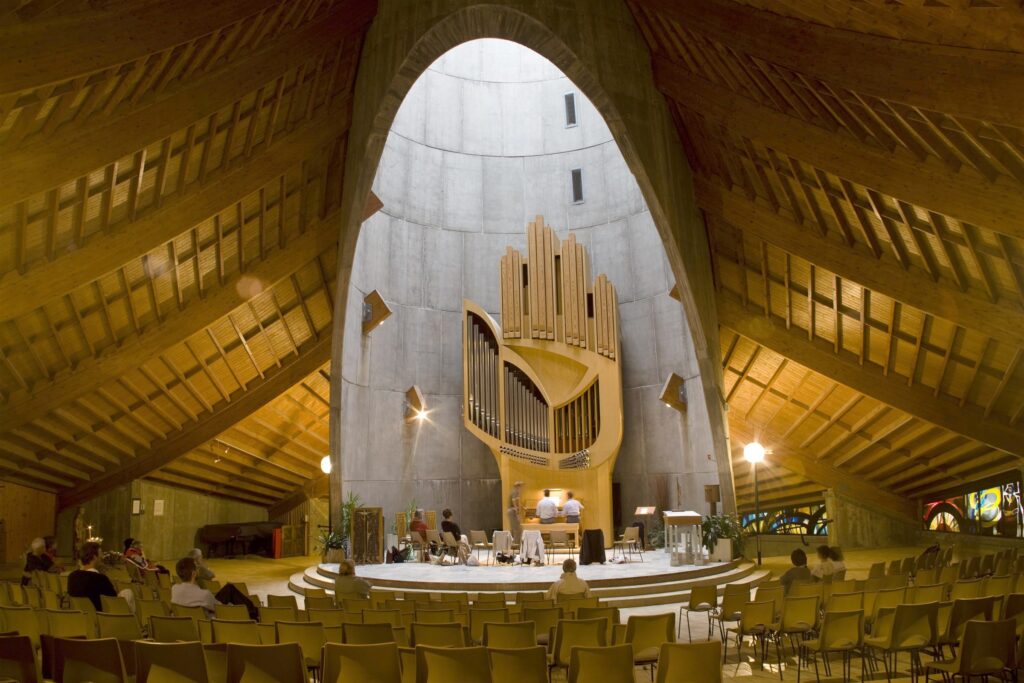
The first symbol, like Abraham in the desert: the shape of the roof follows the soft, rounded movement of this vast shelter. You enter through the choir, the heart of the building: after passing through the half-light of a long entrance (narthex), which lets you grow used to the darkness and prepare for contemplation, you reach a well of light at the centre. This well is also the mast that holds up the tent, the backbone of the building. The congregation sits in a circle around the well of light, as if around a campfire.
Finally, the central mast of this tent is aligned with the two other bell towers of the municipality, those of Saint-Ferréol and Huez-en-Oisans. For its designers, this alignment is a reminder that religion, following the root of the word, is meant to bind people together. Just below lies the crypt.
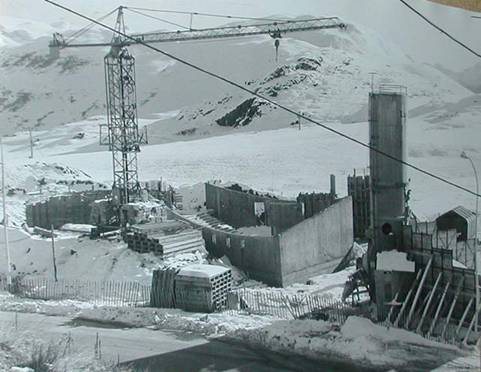
The building site, between 1968 and 1970.
From the crypt to the thirteenth window
The Saint-Nicolas crypt alone was consecrated on 30 December 1968, then the Notre-Dame des Neiges Centre itself was inaugurated on 6 December 1969. The roof was completed in 1970 and the last, thirteenth stained-glass window installed in 2002.
The church is built with simple materials: concrete for the circular frame, copper for the roof, glued laminated timber for the roof structure and translucent glass for the dome. The roof was built by Charles Verguet. Damaged by time, the dome was replaced in 2006 by the association, with the help of the Alpe d’Huez town council and the Isère departmental council.
The thirteen magnificent stained-glass windows are all by the famous artist Arcabas, whose centenary we celebrated in 2026. The church has an organ unique in the world, named Christophe-Raphaël, of exceptional quality and richness, built in 1978 by the organ builder Detlef Kleuker to plans by Jean Guillou.
A church built by its faithful
The construction was funded by donations from many benefactors. That spirit lives on today: it is thanks to everyone’s support that the Notre-Dame des Neiges association maintains the church and keeps it alive.
Heritage
The other churches of Huez
As early as 1058, according to the oldest known document, the lord of Brandes gave the churches of Saint-Pierre de La Garde and Saint-Ferréol d’Huez and the chapel of Sainte-Marie de Brandes to the abbey of Oulx, near Turin.
Saint-Ferréol (at today’s bend 7), which came under the prior of La Garde, served for a very long time as the parish church of Huez, until 1672. As early as 1606, a chapel called Saint-Nicolas had been set up in the village, because Saint-Ferréol was so far away. Its bell tower was repaired in 1899, then in 1959, when the church was entirely rebuilt.
The present church of the village of Huez, Sainte-Anne, was debated for several decades. It was only in 1868, ten years after the terrible fire that had destroyed almost all the houses in the village, that the town council decided to build it; it was completed in 1873.
Bibliography: Églises et vie religieuse des paroisses de l’Oisans (XIe – XVIIIe siècles), Bruno Varennes, Musée d’Huez et de l’Oisans collection, 2002.
The church
Continue your visit
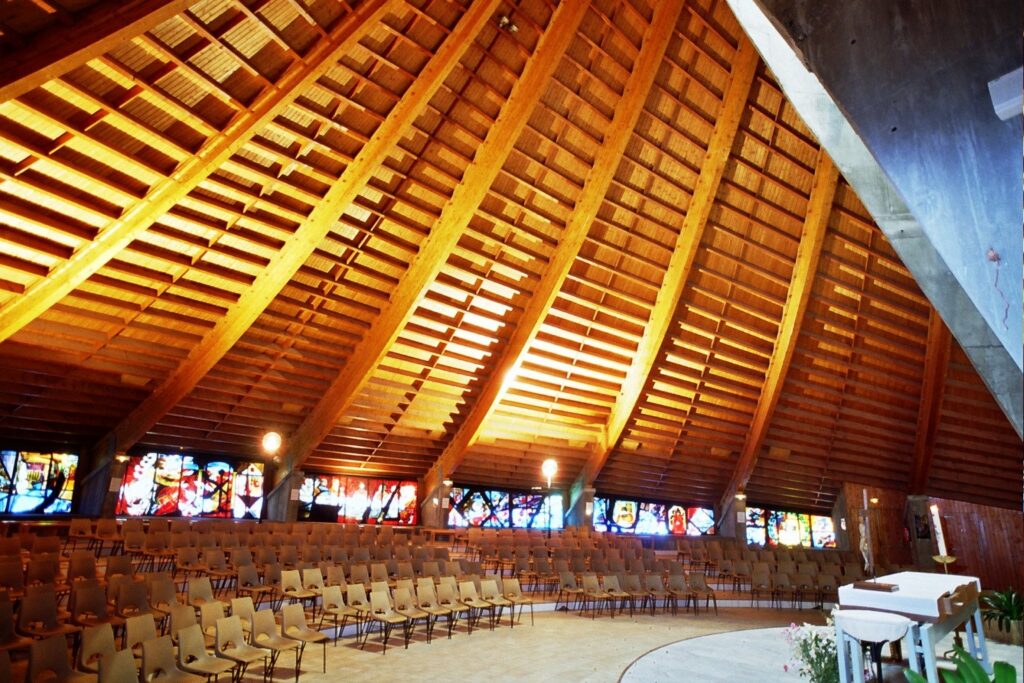
Photos
The church in pictures, inside and out.
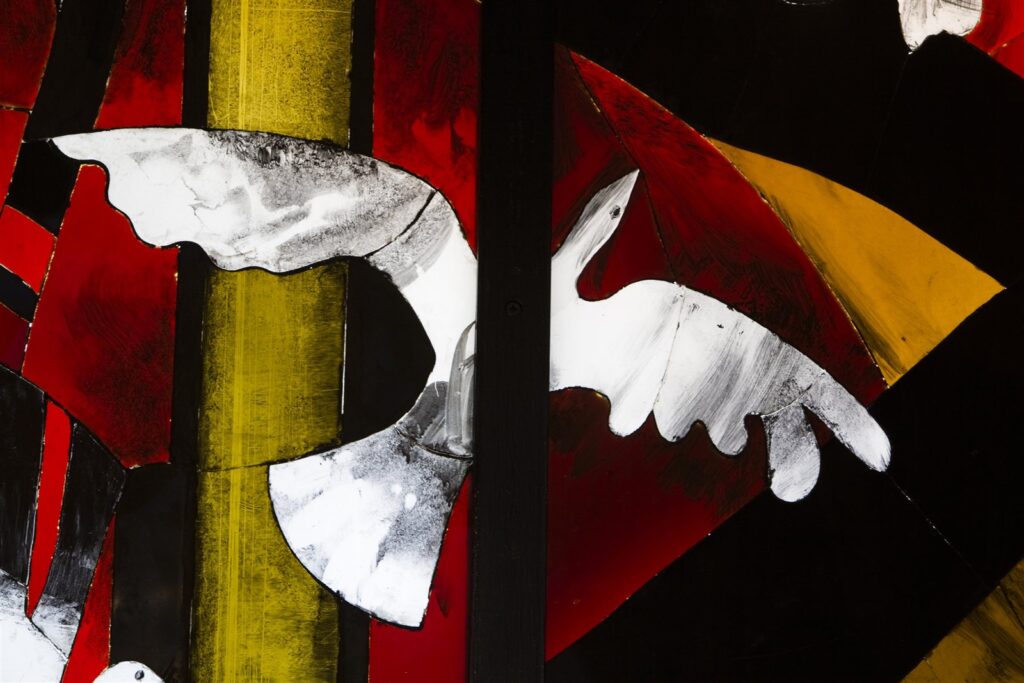
The stained-glass windows
Thirteen stained-glass windows by Arcabas, a painting in light of Mark’s Gospel.
The organ
Jean Guillou’s Kleuker organ and its hand-shaped case.